From Crushed rock to Greatness: Upgrading to Interlocking Paver Driveway Installation
Gravel has its appeals until the 3rd freeze-thaw cycle turns ruts into trenches and your front hall right into a sandbox. I have rebuilt much more gravel driveways than I can count, and the story hardly ever transforms. The first year looks good. By year 2, tires carve washboards, weeds creep in, and the snowplow swipes what the rain didn't. A properly built interlacing paver driveway, by comparison, acts like a solitary, versatile surface. It lugs hefty loads, loses water properly, resists frost heave deliberately, and looks sharp on the first day and year fifteen.
The upgrade is not a little decision. It takes planning, excellent base building and construction, and an eye for detail. But if you desire durability without the fractures you see in put surface areas, interlacing pavers are entitled to a severe look.
What interlocking pavers really do
The pavers themselves are just the noticeable part. The system functions as a device. Interlacing concrete devices with spacer bars set consistent joints. Bedding sand paddings and straightens them. The base, effectively compressed accumulation, disperses lots and drains. Edging restraints lock the field in position side to side. Joint sand, brushed up and shook into the joints, develops friction in between pavers. That friction is the covert strength, the reason loaded trucks don't shove the area out of alignment.
For domestic Driveway Paving Installment, 60 mm thick pavers handle vehicles and most light trucks. If you anticipate delivery van or regular recreational vehicle web traffic, I define 80 mm pavers and a much heavier base. The material sets you back a bit a lot more, yet it is cheap insurance versus rutting or settlement.
Compared with asphalt or monolithic concrete, interlocking pavers approve activity. In environments with frost or large clays, that's a peaceful benefit. As opposed to one large slab that can break, you have thousands of small systems that bend as the base takes a breath with dampness and temperature level swings. When energies need repair service, crews can lift pavers, do their work, and re-install them without awful patches.
Where worth appears, beyond looks
A fresh paver driveway modifications suppress allure right away, however the functional benefits maintain accumulating:
- Snow elimination is cleaner. Rake blades glide, and you do not move crushed rock out of your yard every spring.
- Traction boosts. The microtexture of concrete pavers grips tires far better than smooth poured surface areas, particularly in damp or icy weather.
- Drainage is simpler to manage. With the right base and side grades, water goes where you want. Absorptive paver versions go an action better and let water go through right into an engineered rock reservoir.
Clients recall years later primarily to say the driveway still looks the method it did the week after mount. When interlacing systems age, they do it beautifully. You freshen polymeric joint sand every couple of seasons, place seal if you favor richer color, and deal with the weird oil stain the very same day.
Design selections that matter
A paver driveway is component engineering, component craft. The strongest styles are specific to website conditions, not just the Pinterest vision board.
Paver density and account. As pointed out, paver driveway Walnut Creek 60 mm is conventional for cars and trucks. I utilize 80 mm when preparing for point tons at turn-arounds, steep slopes, or frequent service cars. Rolled or chamfered sides can mask small negotiation and decrease chip danger at the corners.
Pattern and alignment. Herringbone withstands shear far better than running bond, specifically under turning tires near the garage door. For lengthy straight drives, a 45-degree herringbone breaks up the runway feeling and spreads out car forces in several instructions. Boundaries in a different color structure the area and include restraint.
Color and structure. Sunlight and road crud mute bright tones gradually. Mid-range grays, charcoals, and mixed planet tones conceal tire dust and dried out salt far better than really light or extremely dark units. Textured faces provide grasp without ending up being a catch for shovels or strollers.
Edges and changes. The areas that fall short initially are constantly the edges. Use durable concrete curbing or surged aluminum/steel restraints established into compressed base, not simply into bed linen sand. Transitions to a garage slab need a hairline expansion space, a tidy straight line, and specific elevation control to prevent a lip.
Drainage. A driveway is a roofing you park on. Give water a plan. A slope of 1.5 to 2 percent is typical, but existing topography will direct that decision. Keep water relocating away from your home and toward a swale, dry well, or storm system. In hefty clay soils, underdrains within the base stop perched water that can freeze and lift.
Permeable or conventional. Absorptive interlacing concrete pavers, with open-graded stone in the joints and base, allow water infiltrate. Where neighborhood codes motivate seepage or where you want to lower topping from drainage, absorptive systems deserve the included base deepness and maintenance programs. Traditional pavers with polymeric sand joints shed water, which can be better on steep slopes or under thick tree cover that goes down fines.
Turning crushed rock into a ready subgrade
A gravel driveway hardly ever has consistent deepness or regular rank. Prior to you fantasize about patterns and colors, understand what is under your tires.
Start by penetrating. Drive a steel rod or rebar at a grid of points to feel for soft pockets, old fill, or hidden organic matter. If your building rests on large clay, it will certainly telegram gentleness after a rain. Sandy loams drain swiftly but can rut if not compacted. For frost-prone areas, intend on eliminating topsoil and all organics to subject strong subsoil, then reconstruct with well-graded, angular stone.
Depth issues. For passenger vehicles in modest environments, I target 8 to 10 inches of compacted base under the 1 inch of bedding sand and the paver density. In frost nation or for heavier tons, 12 to 16 inches is sensible. That is compacted deepness, not loose. A typical mistake is to get the exact numbers and fail to remember compaction decreases volume by 20 to 30 percent. Order extra, and aim for 95 percent Proctor thickness throughout the base.
Anecdote from a job in Vermont: a 1,200 square foot sloped driveway over silty soil. We drew 14 inches of blended crushed rock and organics and rebuilt with 10 inches of 3/4 inch minus plus fines, compressed in four lifts, after that 2 inches of 3/8 inch chip as a maintaining top of base, 1 inch screeded bed linens sand, and 80 mm herringbone pavers. Plowing the next wintertime showed no blade babble and no visible change at the garage apron.
Materials, quantities, and what they actually cost
Costs differ with region and market cycles, so believe in ranges. For common residential Driveway Paving Installation with quality concrete pavers, anticipate:
- Pavers: generally 4 to 8 bucks per square foot for mid-grade items. Premium structures and multi-piece blends can reach 9 to 12.
- Base stone and bed linen sand: frequently 2 to 4 bucks per square foot combined, relying on depth and trucking.
- Edging, geotextile material, and joint sand: approximately 1 to 2 bucks per square foot.
- Labor: for a professional crew, 6 to 14 dollars per square foot based on accessibility, cuts, contours, and website job complexity.
DIY can trim labor, however plan for tools leasing and time. A small plate compactor, a saw with a wet-cut blade, string lines, screed rails, and a transit or laser level all earn their maintain. I have actually seen passionate do it yourself jobs stall when people ignore base excavation or the tedium of cutting a tidy soldier training course around curves. If the driveway exceeds about 700 square feet or consists of significant quality adjustment, the majority of property owners are better working with a crew.
A note on geotextile. Under the base, nonwoven geotextile prevents the stone from pumping right into the subgrade. On clay or in old crushed rock driveways with blended penalties, it is cheap insurance coverage. It additionally speeds up compaction by dividing fines from your angular stone.
The develop, phase by phase
Excavation and subgrade preparation established the tone for everything that follows. Strip organics, dig to the prepared depth plus an added 6 to 12 inches past the finished side to support restrictions, and shape a constant incline. Proof roll the subgrade to find soft places. Undercut those and replace with compressed stone. Lay geotextile material tight to the dirt, overlapping joints by at least a foot.
Base setup takes place in lifts. Area 3 to 4 inches of well-graded, angular stone, after that portable up until the machine changes tone and the surface stiffens. Repeat up until you reach the design elevation, maintaining the incline regular. For lengthy drives, I run string lines and examine often with a laser. Do not utilize pea gravel or any rounded rock in the base. It will never lock and will certainly remain to shift.
Bedding sand is not a padding for wrongs listed below. Usage concrete sand, screeded to a true 1 inch. Set pipelines or screed rails at the best elevation, draw a straightedge to create an even plane, and work in areas you can lay pavers on the very same day. Do not stroll on screeded sand; it creates soft pockets that telegraph later.
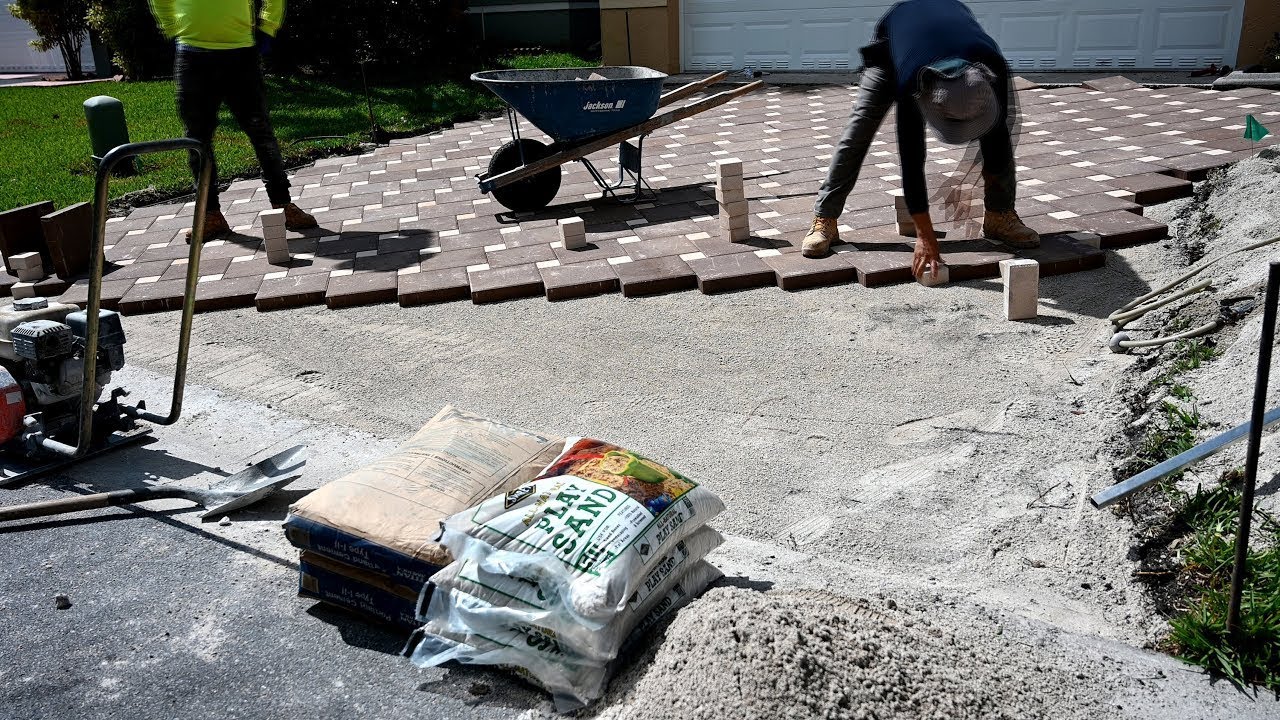
Laying the area begins with a straight, well-controlled edge. I prefer to set a header or border initially, after that run the field pattern off that control line. Keep joint lines tight and constant. Surprise splices when opening up numerous pallets so color blends naturally. As you lay, examine the pattern against barriers like cleanouts or light posts to stay clear of tiny slivers that chip later.
Cutting and edges make or damage the appearance. Damp saws give the cleanest cuts and control dirt. For contours, a series of little straight cuts then a gentle gloss pass generates a tight line with minimal damaging. Set up side restraints on compacted base, out bed linen sand, and surge them hard. Backfill on the outside of the restriction with base stone and portable to secure it.
Compaction and jointing connect the system together. Run a plate compactor with a protective pad over the laid field to seat the pavers right into the bed linen sand. Move in jointing sand, then compact once again to vibrate sand deep right into the joints. I typically favor polymeric sand for driveways, triggered with a light mist. It resists washout and weeds far better than simple sand if applied in dry weather with careful cleanup.
Final checks issue. Run your hand across shifts to the garage or street to really feel for lips. Flooding test troublesome places with a tube to confirm water flows as meant and does not pond. Change where possible prior to the sand is totally locked.
A compact planning checklist
- Confirm subsoil kind and drain path prior to wrapping up base depth.
- Choose paver thickness and pattern based on expected loads and turning areas.
- Plan edges and changes with exact elevations, not approximations.
- Decide traditional vs permeable early, since base style adjustments substantially.
- Order 5 to 10 percent extra pavers for cuts and future repairs.
Integrating the sidewalk and front entry
Driveways set the tone, however the initial step from vehicle to door chooses how the task feels. Bringing the exact same combination into Walkway Paving Installation develops a visual thread while allowing useful differences. On strolls, thinner 60 mm pavers are almost always enough, and patterns can shift to a running bond or basketweave that complements a herringbone drive. Maintain the sidewalk a little crowned or pitched so water leaves the surface area, specifically under roof covering eaves.
Where a pathway branches from the driveway, offer it a distinct junction. I such as to make use of a soldier course boundary that runs undisturbed around both surfaces so the eye reads one natural style. If steps are required, pour concrete risers or build solid block steps under the pavers as opposed to relying on stacked pavers alone. The latter will loosen with freeze-thaw and foot traffic.
Lighting is simpler to include during setup. Low-voltage conduits under the base allow you add course lights or step lights later on without saw cutting. For utility crossings like irrigation lines, hide sleeves before you portable the base.
Drainage pitfalls, and just how to stay clear of them
Driveways usually rest less than the road and greater than the lawn. That invites problem if you disregard where water wishes to go. 2 patterns recur.
First, the garage doorstep lake. The driveway slopes towards your home for the final couple of feet, or has a minor dip that catches meltwater. Fix it on paper by establishing the garage apron elevation early and pitching the driveway away at a consistent 1.5 to 2 percent. Where whole lot restrictions force a back pitch, a trench drainpipe at the apron tied to a dry well is much better than wishing for the best.
Second, the swale dam. A new driveway intersects a lawn swale, after that edge restrictions act like a berm that sends out water throughout the driveway or onto a neighbor's building. The remedy is basic preparation. Reduced an area of the side via the swale, thicken the base, and maintain the swale quality under the drive. This is more excavation and product, however it prevents erosion and neighborly disputes.
Permeable systems change the conversation by storing and penetrating water, however interlocking driveway pavers East Bay they are not a magic bullet. Do not put permeable bases in high groundwater or on hefty clays without underdrain alleviation. The joint rock will certainly obstruct under heavy fallen leave fall otherwise maintained. Decide with dirt tests, not marketing brochures.
Common errors that set you back cash later
- Skipping geotextile on suspect subgrades, bring about base contamination and settlement.
- Using rounded pea crushed rock in the base, which never ever compacts right into a stable layer.
- Placing edge restrictions on bed linens sand rather than compressed base, welcoming creep.
- Rushing compaction, particularly at shifts, developing lips and trip points.
- Ignoring color mixing by laying one pallet at once, which produces blotchy fields.
Maintenance that keeps the surface area tight
A paver driveway is low maintenance when built right. Low does not suggest no. Each to three years, depending on website traffic and climate, evaluate joints and top up polymeric sand where required. Keep joints complete. That is the solitary best defense versus weed growth. Pressure laundry sparingly, with a large fan and moderate stress. You intend to cleanse the surface, not deteriorate the joints.
Oil and rust stains react best to fast action. Blot fresh oil, then utilize a paver-safe degreaser. For rust from grass furniture or lawn sprinkler water, oxalic acid cleansers function, however rinse completely and re-sand joints if you clean strongly. Efflorescence, a white haze from migrating salts, can show up in the initial period. It fades naturally, or you can treat it with purpose-made cleansers once the pavers and sand are fully cured.
Winter brings salt and freeze-thaw. Many high-grade pavers stand up to deicing salts, however calcium magnesium acetate is gentler if you want to beware. Usage plastic shovels or set the snowblower skids a little high to prevent scuffing. A well-compacted base and correct jointing make blade babble rare.
Repairability and lifespan
One of the real enjoyments of interlacing systems is exactly how they deal with damages. If a delivery truck goes down a pallet edge and chips a couple of devices, you pull the damaged location, swap pavers, re-sand, and the repair is unnoticeable. If negotiation occurs due to a missed out on soft spot, you can raise a panel, remedy the base, and relay the same pavers. Attempt that with asphalt.
Expect a 25 to 40 year life span for the paver units themselves, occasionally much longer. The base, if constructed deep and dry, will last longer than the surface area. Joints will require periodic revitalizing. Sealing is optional. It deepens shade and can reduce discoloration yet calls for reapplication every couple of years. If you like the natural matte appearance and very easy breathing of the surface area, avoid sealer.
Permits, codes, and neighbors
Municipalities and HOAs usually have viewpoints about paving products, driveway width, and drain. Check early. Some towns offer stormwater debts for permeable pavers. Others call for a driveway apron information at the street or certain problems. For rural drives, think about where snow storage lands so you do not bury a fire hydrant or block sightlines.
Construction sound and dust are temporary however real. Excellent professionals manage dirt with water during saw cuts and keep the site neat. If you do it yourself, intend the logistics. Staging pallets near the work conserves days of wheelbarrow hauls. Protect existing concrete and asphalt from scratchy pallets and stray stone with plywood.
A task tale, numbers and outcomes
One of my favorite upgrades involved a 90 foot L-shaped crushed rock drive with a limited bend near the garage. The proprietors hosted large family members events and were tired of dust. Their children tracked grit right into the mudroom regularly. The website had a gentle cross slope towards a rainfall garden, which we used to our advantage.
We got rid of 12 to 14 inches across 1,800 square feet, located a few soft capillaries of old topsoil near the bend, undercut and changed those with compressed stone. A nonwoven geotextile divided subgrade from base. We built 12 inches of compacted base rock, after that 1 inch of bed linens sand. The field pattern was 45-degree herringbone in a combined charcoal, with a lighter gray boundary that matched their porch rock. At the garage apron, we set a real zero-lip change. Complete install time with a four-person crew, devices, and 2 wet days was nine working days.
The proprietors included a walkway that branched from the driveway to a side entrance. We moved to a running bond pattern on the stroll with the same boundary shade, and we tucked conduit for future path lights under the base. Throughout the initial winter months, the husband phoned call to claim raking took half the time, and the mudroom rug remained clean for the first season given that they acquired the house. That is the type of improvement you can gauge on a schedule and a vacuum bag.
DIY or employ a crew
If you have solid excavation abilities, a convenience level with qualities, and a few able helpers, a little straight driveway is available. Prepare for long days and sore shoulders. The much heavier and more intricate the layout, the even more a professional crew makes its cost. Pros bring compaction testing by experience, not simply number of passes. They detect drain traps before they come to be ice patches. They make it that separate a neat edge from a jagged guess.
I frequently suggest home owners manage the style and product choice, after that bring in a professional for the base and paver setup. That hybrid technique allows you handle costs while ensuring the vital layers satisfy spec.
Sustainability and product choices
Concrete pavers are power intensive to make, yet many manufacturers integrate recycled aggregates or cement substitutes to decrease embodied carbon. Permeable systems lower drainage and assistance recharge groundwater. In your area sourced base rock cuts trucking exhausts. For lengthy drives, easy patterns with very little cutting lower waste. Choose pavers with tight dimensional control and frost-resistance ratings ideal to your climate to prevent premature replacements.
If you replace an old gravel drive, do not lose the existing stone. Tidy, angular material can be recycled as part of the brand-new base if it satisfies rank and tidiness criteria. Spherical or unclean material belongs somewhere else, not under your pavers.
Bringing everything together
Upgrading from gravel to interlocking pavers modifications day-to-day live in small manner ins which build up. You park on a surface that looks purposeful and deals with your home, not versus it. Tires do not spray pebbles. The initial step out of the auto is firm and clean. Snow does not claw up your lawn. And if something under the surface requires interest, you do not face a full tear-out to deal with a tiny issue.
Executed with care, a paver driveway acts like a sturdy road scaled to a home. Respect the base, provide water a course, secure the edges, and your Driveway Paving Setup will carry the years with silent confidence. If you expand the palette to your entry path with thoughtful Sidewalk Paving Installation, the entire technique to your home will certainly really feel composed and sensible. That is the leap from gravel to achievement, not simply for appearances, but also for exactly how the place works day after day.